Two distinct attempts to smuggle cultural relics across the border have been foiled at West Kowloon Station, underscoring the continuous efforts to crack down on the illegal transportation of historical artifacts—even along the route connecting Hong Kong and the Chinese mainland.
In one instance, customs officials stopped a foreign male traveler who was traveling from Hong Kong to the mainland and had not declared his belongings. An X-ray examination of his suitcase revealed suspicious items, prompting a thorough inspection. During the check, officers seized a large haul of artifacts, including 1,923 stamps from the Republic of China period and 252 tax stamps—all categorized as cultural relics with restricted cross-border movement. More notably, they also found items that are strictly banned from being taken across the border: 3 foreign stamps dating back to the 19th century, 48 stamps from the puppet Manchukuo regime, 8 silver coins from the 18th year of the Republic of China, and a Qing Dynasty “Guangxu Yuanbao” silver coin.
This incident was by no means an isolated one.
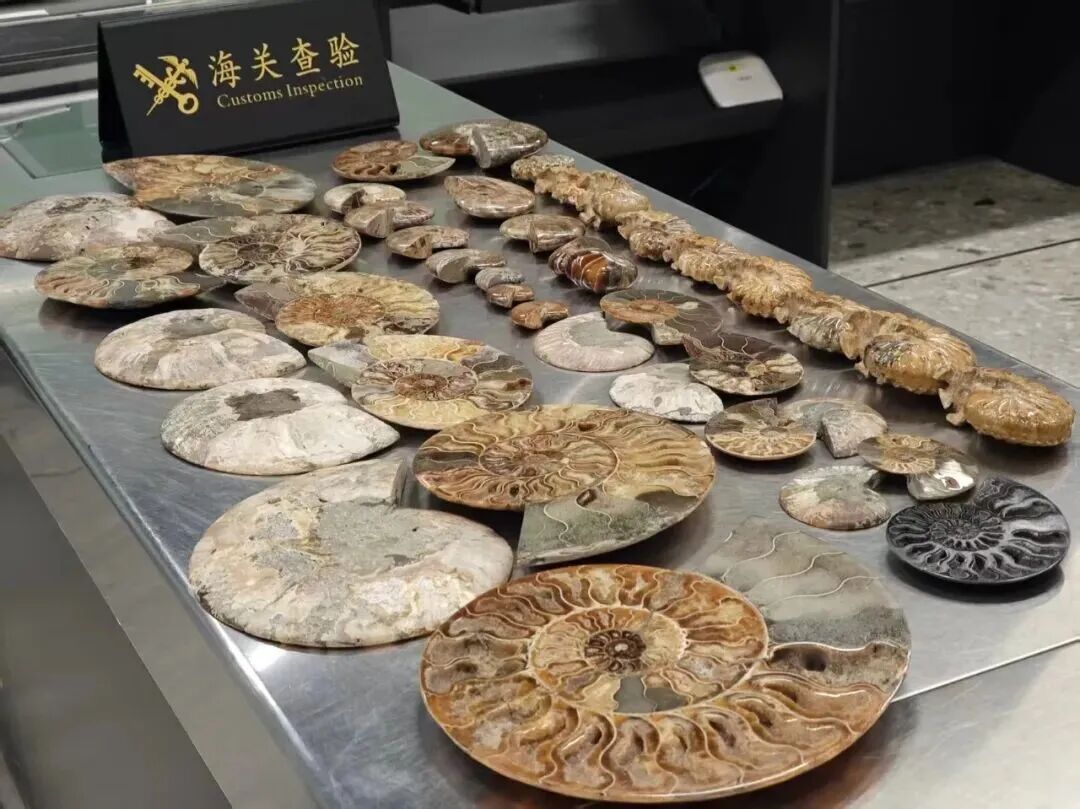
Shortly before this case, another foreign traveler was intercepted while trying to bring 680 coins, banknotes, and 42 fossil specimens from Hong Kong into the mainland. Once again, customs officers noticed irregularities during the luggage scan. Inside the suitcase, the items were meticulously wrapped in bubble wrap. After unpacking, the officers discovered 574 ancient Chinese and foreign coins, copper coins from the Republic of China era, Hong Kong silver coins, and 106 banknotes from the Republic of China period—many of which are either restricted or prohibited from cross-border transfer as cultural relics.
The seized items were not limited to currency.
Authorities also identified 40 ammonite fossils and 2 nautiloid fossils, all of which are classified as protected paleontological specimens.
Under Chinese law, any cross-border movement of cultural relics or fossils—regardless of the direction, including between Hong Kong and the mainland—requires prior declaration and official authorization. All items must be reviewed by designated authorities, and a permit must be obtained before transportation. Non-compliance can lead to severe legal penalties.
These cases serve as a clear reminder: even on seemingly ordinary routes, the unauthorized transfer of historical artifacts and fossils is subject to strict oversight.